Window Crystals And Suncatchers: Making A Rainbow Corner
 By Lisa Ben
·
October 9, 2026
·
8 min read
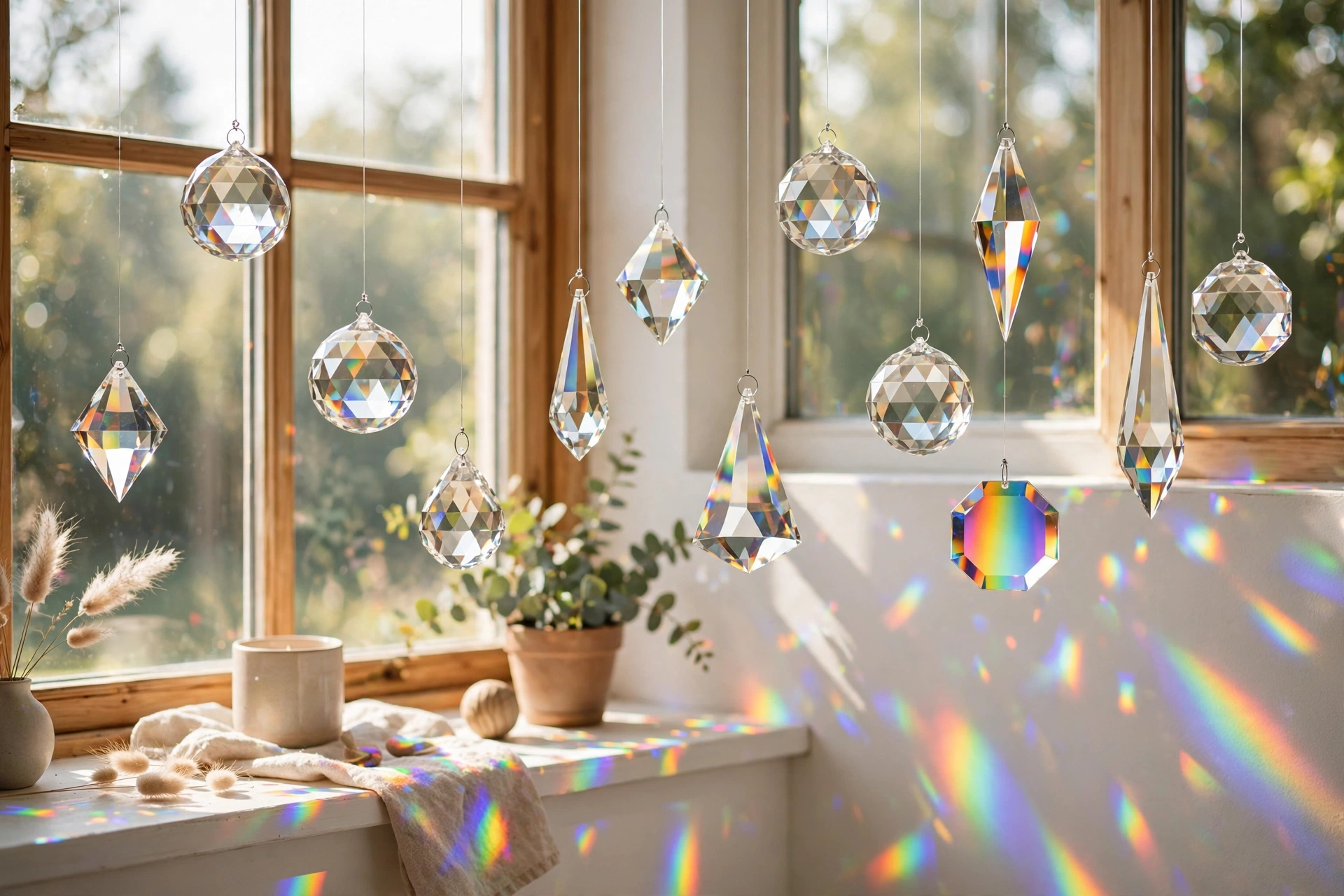
The first time it happened I thought something had spilled. Little coins of colour were sitting all over the kitchen wall, pink and green and gold, moving so slowly I nearly missed it. Nothing had spilled. A faceted crystal I had hung in the window the day before had caught the morning sun, and it was throwing rainbows across the room like it was being paid by the hour.
I now have five in that window, and on a clear morning the corner by the plant shelf looks like someone dropped a bag of sweets in a sunbeam. It is the cheapest decorating trick I know. It is also one of the easiest to get wrong, because a crystal in the wrong window, or the wrong kind of crystal, does absolutely nothing. This post is everything I have learned, including the wasted money.
How a crystal turns sunlight into rainbows
Sunlight looks white, but it is really all the colours mixed together. When it passes through glass it bends slightly, and each colour bends by a slightly different amount, so the mix fans out into separate colours. That fanning-out is all a rainbow ever is, in the sky or on your wall.
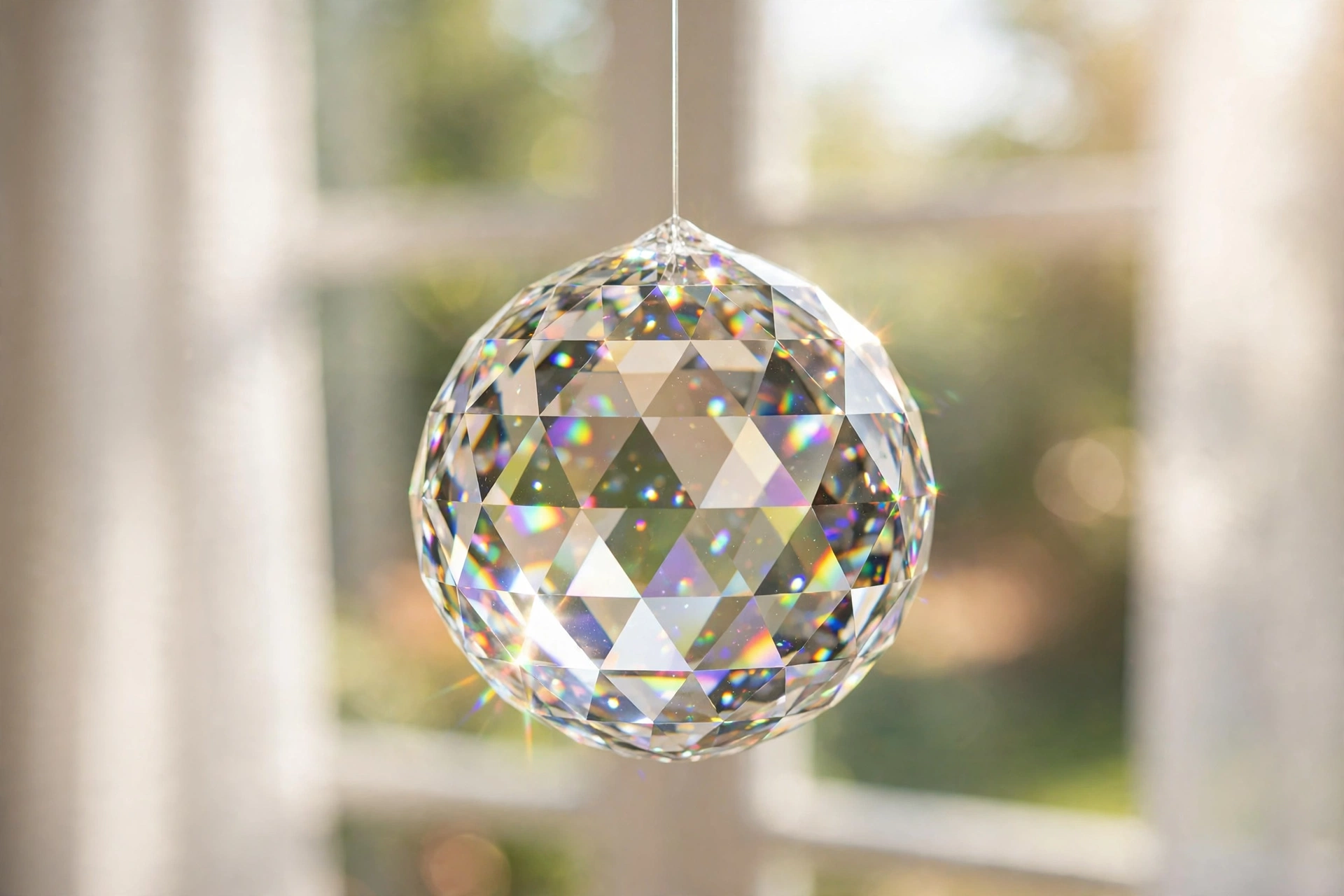
A faceted crystal is covered in small, flat, angled faces, and every face bends the light its own way. That is why one crystal throws dozens of little rainbow patches instead of one big stripe. Two things follow from this. First, the facets need to be clean and sharp: dust and grease soften the edges, and soft edges make muddy colour. Second, shape matters more than sparkle. A smooth glass ball or a rounded novelty shape barely bends anything. It will glow politely in the sun and throw almost no colour at all. My first purchase was a smooth glass strawberry. Lovely paperweight. Terrible rainbow maker.
Pick the window first, buy the crystal second
Crystals need direct sun, the hard kind that lands in a bright patch on the floor. Bright indirect light, the sort that makes a room feel cheerful, will not do it. If the sun never actually reaches the glass, there is nothing to split.
An east-facing window is the champion, because morning sun comes in low and level and rakes straight through a hanging crystal into the room. South-facing windows give you a good show around the middle of the day. West-facing windows save their rainbows for the evening, which is lovely if that is when you sit in the room. A north-facing window gets no direct sun at all in most homes, and a crystal hung there will just hang there. I know, because mine did, for a month, while I blamed the crystal.
Before you buy anything, spend a few days noticing where the sun actually lands in your house, and at what time. Watch for a week if you can: a tree or a neighbour's roof can steal a window's sun for part of the year. Hang your crystals where the patch hits the glass, at the time of day you are usually around to enjoy it.
What to buy, and what to walk past
The shapes that work are the ones with plenty of flat faces. Faceted crystal balls, usually 30 to 40mm across, throw lots of small patches in every direction and are the easiest place to start. Flat prisms and teardrop pendants throw fewer patches, but bigger and more defined ones, more like little rainbow flags. Chandelier drops, the long pointed crystals from old light fittings, are my favourites: they behave like prisms and they are often the cheapest way to buy real glass.
Glass versus plastic is the big decision, and it is not close. Acrylic and plastic suncatchers are cheap and light, but the material scratches, clouds over time, and throws weak, washed-out colour even when new. Glass is heavier, costs a bit more, and the rainbows are in a different league. If the listing does not say glass, assume it is not.
The cheap route to real glass is second-hand. Charity shops and house-clearance sales regularly have battered old chandeliers and crystal light fittings going for very little, and a fitting nobody wants can hold a dozen perfect crystals. Check each one for chips on the edges, which dull the effect, and for cloudiness that does not wash off. One more shopping tip: beaded strands and crystal garlands look generous in photos, but the facets are tiny, so you get sparkle rather than rainbows. Pretty, but a different thing.
My shortcut: buy one good glass crystal first, around 40mm, and live with it for a week in your sunniest window. If it makes you grin, add more. One honest crystal teaches you more than a bargain set of nine plastic ones.
How I hang mine
I hang crystals on fishing line, the fine monofilament kind, because it all but disappears and the crystal seems to float. A simple knot at the crystal's loop, and either a knot or a tiny dab of superglue at the top end, is enough for something this light. Vary the lengths so the crystals sit at different heights rather than in a soldier's row.
You have two ways to fix the top end. A suction cup on the glass is quick and leaves no marks, which renters will like, but I will be honest: suction cups let go. Heat softens them, the seal ages, and sooner or later one gives up, usually at 3am, loudly. If you use them, press them onto clean, dry glass, check them every few weeks, and always hang the crystal where a fall means landing on the sill, not the floor. A small hook or cup hook screwed into the wooden window frame is uglier to install and far more secure. That is what mine hang from now.
Two safety points worth the sentences. Hang crystals where a falling one lands on a sill or something soft, never above where heads, babies or the dog's bed live. And hang them a little away from the glass itself: in a draught a swinging crystal will tap the window, and tapped glass plus a chipped crystal helps nobody.
Placement experiments worth trying
Height decides where the rainbows land, and this is the bit nobody mentions. A crystal hung high throws its patches high, onto the ceiling and the top of the far wall. Lower it, and the patches travel further and land lower, across the floor and the sofa, where people actually see them. If your rainbows are decorating a ceiling nobody looks at, your crystal is simply too high.
Movement is the other half of the magic. A still crystal throws a still rainbow, nice enough. Give it the faintest slow turn and every patch sweeps and multiplies across the room. A window left open a crack on a breezy morning does this for free, which is how mine spend most sunny days. You can buy little solar spinners that rotate them, and they do work, but try a draught first.
As for numbers: one crystal alone in a big window looks a bit lost and throws a modest show. Three to five, at staggered heights with space between them, is the sweet spot in my kitchen window. Odd numbers arrange themselves more kindly than even ones, which I did not believe until I hung four.
The rainbow corner: crystals over the plant shelf
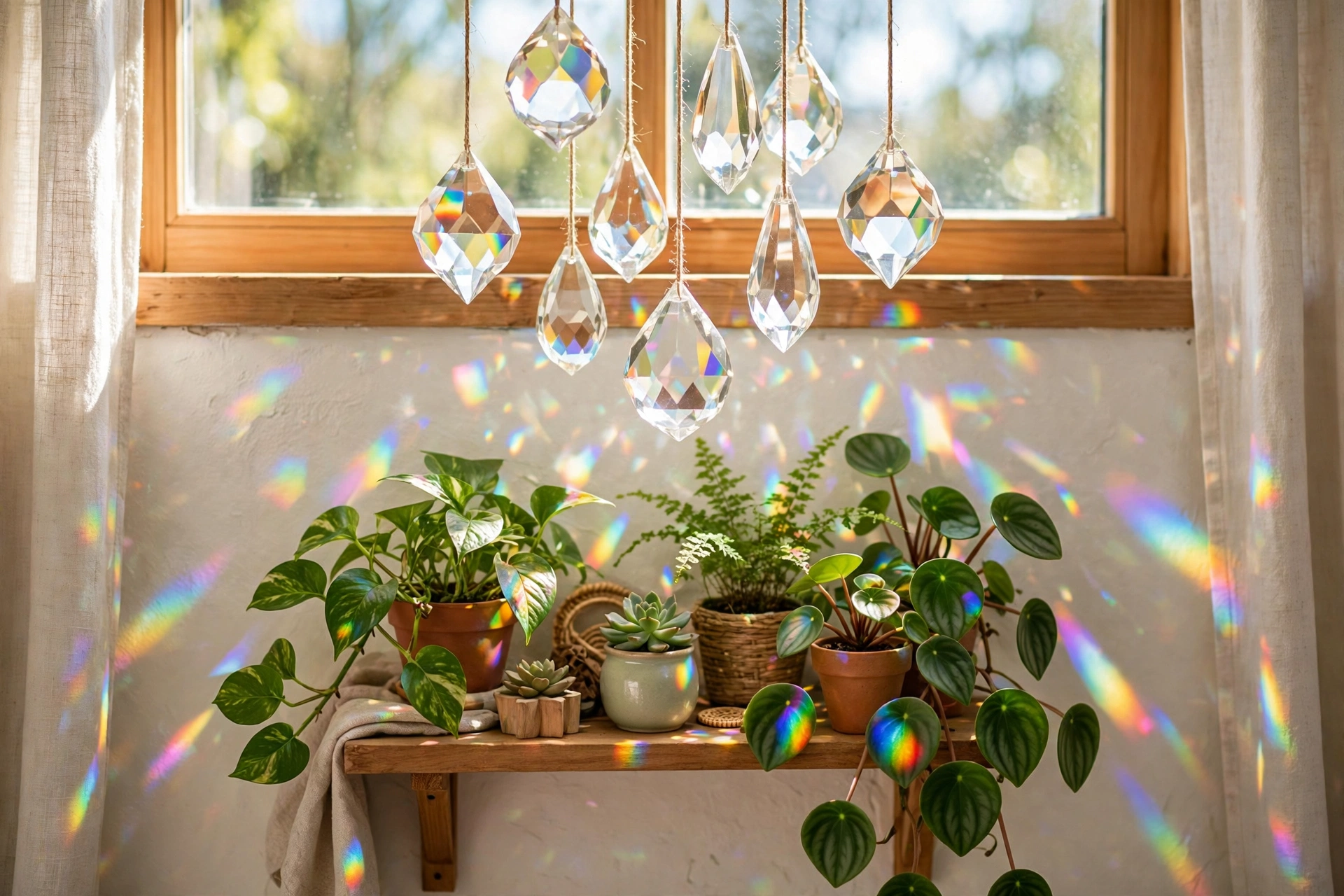
My favourite version of this trick pairs the crystals with plants. I built a simple window plant shelf across the same kitchen window for herbs and small pots, and the crystals hang above it, out of reach of watering splashes. On a sunny morning the rainbow patches drift across the leaves and the pots, and the whole corner looks lit from inside.
It is theatre, not plant care. The coloured light does nothing measurable for the plants, and I would not claim otherwise. But as a corner to stand in with a cup of tea at 8am, it earns its keep completely. If you copy one thing from this post, copy the pairing: something green below, something sparkly above, and the sun doing the rest.
Keeping them clean
Dusty facets throw dull rainbows, and kitchen windows collect grease faster than any other glass in the house. Every few weeks I take mine down and wash them in warm water with a drop of washing-up liquid, rinse, and dry them straight away with a lint-free cloth so no water marks dry onto the faces. Paper towel is the enemy here: it leaves lint on glass and can scratch acrylic, if you ignored me and bought acrylic. Handle glass crystals by their edges and you will add fewer fingerprints to wash off next time.
The honest limits
Rainbows only happen while direct sun is on the window, which for most of us means an hour or three, not a day-long display. A cloudy week gives you nothing at all; the crystals just hang there looking decorative, which luckily they also do well. The sun's path shifts with the seasons too, so a crystal that floods the room in June may miss its moment in December and need moving along the window.
Crystals also add no light to a room. They rearrange the sunlight that arrives; they do not create more of it. A genuinely dark room needs a plant that copes with shade and a decent lamp, not a suncatcher. And a word about the claims you will meet while shopping: plenty of listings promise that a crystal in the window will fix a room's energy, or other feng shui benefits. I make no promises in that direction. I bought mine for the light show, the light show is real, and that has always been enough for me.
Mistakes I have already made for you
- The plastic set. Nine acrylic crystals, very cheap, very cheerful in the photos. In my window: a faint sparkle and colour so weak I had to squint. Replaced with glass within the month.
- The wrong window. My first real crystal hung in a bright north-facing window and produced nothing for weeks. Bright is not the same as direct sun. Moved it to the kitchen, instant rainbows.
- Hung too high. I put the line right at the top of the frame and decorated the ceiling every morning. Lowered by a hand's width, the patches landed on the wall and the table instead.
- Never cleaning them. By the second month the rainbows had faded to a rumour. Ten minutes with soapy water brought them back. Dust is a dimmer switch.
Questions I get asked about window crystals
How many crystals do I need to start?
One. Buy a single glass faceted ball around 40mm, hang it in your sunniest window, and see what it does at different times of day. If it delights you, build up to three or five at staggered heights. Starting with one also teaches you your window's sun, which decides everything else.
Will a suncatcher work in a north-facing window?
Honestly, no. North-facing glass gets bright light but almost never direct sun, and direct sun is the whole mechanism. The crystal will sparkle faintly and that is all. Put your crystals in whichever window gets a hard patch of sun, even if it is the bathroom.
Are hanging crystals safe around children and pets?
They can be, with the boring precautions taken seriously. Hang them well out of reach, on a proper hook rather than a tired suction cup, and think about the landing zone: a falling crystal should meet a sill or a rug, not a head or a tiled floor. Glass is breakable, so treat it like anything else glass in the house.
Crystal ball or flat prism: which throws better rainbows?
Different, rather than better. A faceted ball throws many small patches in every direction, a cheerful scatter. A flat prism throws fewer, larger, more defined bands of colour, closer to a classic rainbow stripe. I run a mix: balls for the scatter, one good prism for the big stripe across the wall.
Start with one real glass crystal, the sunniest window you have, and a week of watching where the light lands. The rainbows will handle the rest. Tell me in the comments which way your best window faces, and whether your patches land somewhere worth sitting.
Lisa Ben
Lisa paints, builds, thrifts and rearranges her way through one very patient house, then writes down everything she learns here on Wazala. New projects land every Tuesday, Thursday and Saturday, and the Sunday Letter rounds them up once a week.
You might also like

Easy Window Plant Shelf For A Sunny Kitchen
One extra shelf across a sunny kitchen window for herbs and small pots. Simple brackets, one plank, and the tray that saves the sill from drips.
Read more →
Propagate Pothos: Turn One Plant Into Twelve
Snip, root in water, pot up. The easiest houseplant multiplication you will ever do.
Read more →
7 Plants That Survive Rooms With Almost No Sun
Seven plants that genuinely cope in rooms with almost no sun, including the two in my hallway where nothing else lasted more than a month.
Read more →