Rug Sizes That Actually Work, Room By Room
 By Lisa Ben
·
October 26, 2026
·
12 min read

If your living room has ever felt slightly wrong and you could not put your finger on why, look down. Nine times out of ten it is the rug. Mine was a pretty patterned thing I loved in the shop, and once it was home it sat under the coffee table like a bath mat that had wandered in from another room. The sofa floated behind it, the chairs hovered at the edges, and nothing in the room seemed to know the rest of it was there. I rolled it up, ordered the same pattern two sizes bigger, and the whole room settled. Nothing else changed. That is how much quiet work a rug is doing, and why its size matters more than its pattern, its colour, or what it cost.
The one rule: a rug anchors furniture, it does not float
A rug has one job, and it is not keeping your feet warm, though it does that too. Its job is to hold a group of furniture together. Think of it as the floor the furniture is standing on while it talks to itself. The sofa, the chairs and the coffee table are one conversation; the rug is the ground they share. When a rug touches nothing but the coffee table, the group falls apart and every piece reads as separate, parked there by accident. When the legs of the seating land on the rug, even just the front legs, the pieces become one deliberate arrangement. The room looks planned, because it is.
A small rug floating in the middle also shrinks the room. Your eye reads it as a little island and everything beyond it as leftover space. A bigger rug pulled under the furniture does the opposite: the seating area becomes one generous zone, and the room feels larger and calmer at the same time. Nearly every sizing question below is just this rule wearing different clothes.
The standard sizes you will actually meet
Rugs mostly come in a handful of standard sizes, and it helps to know them before a shop assistant starts waving a tape measure at you. These are the four that cover nearly every room in nearly every house:
| Size (cm) | Size (feet & inches) | Usually fits |
|---|---|---|
| 160 × 230 cm | About 5′3″ × 7′7″ | Small living rooms, front legs on; bedrooms with a double bed |
| 200 × 290 cm | About 6′7″ × 9′6″ | Most living rooms; dining tables for six; under a king bed |
| 240 × 340 cm | About 7′10″ × 11′2″ | Large living rooms with all legs on; open-plan seating zones |
| 70 × 240 cm (runner) | About 2′4″ × 7′10″ | Hallways, kitchen worktop runs, beside a bed |
You will find sizes just above and below these too, and runners come in longer lengths, but if you walk in knowing these four numbers, you can size any room in this post in about a minute. One habit worth starting now: the size printed on the label is the whole rug, edge to edge, including any border pattern. Measure your floor for the full thing.
Living room: front legs on, as the minimum
Start with the seating, because the seating is the point. The minimum arrangement that works is front legs on: the front legs of the sofa and of every chair in the group sit on the rug, the back legs stay on the floor. It sounds like a compromise and it is, but it is the good kind. The rug still ties the group together, the room keeps some breathing space, and a standard size will usually do it. If your room and your budget stretch to the biggest standard size, all legs on looks calmer and more generous still, and it is the right call in a big room where the sofa sits away from the walls rather than against them.
Whatever you choose, leave a border. Aim for roughly 20 to 45 cm (about 8 to 18 inches) of bare floor between the edge of the rug and the walls or skirting boards. Any less and the rug stops reading as a rug and starts reading as carpet that shrank in the wash. That border of floor is what tells the eye the rug was chosen for the room, not fitted to it. In a small room you will land nearer the 20 cm end; in a large one, nearer 45 cm. Both are fine. Wall-to-wall is not.
Two details that catch people out. First, centre the rug on the seating group, not on the room, if the two disagree. The rug serves the furniture; the walls can look after themselves. Second, everything that belongs to the conversation should touch it, coffee table included. A chair parked just off the rug's edge looks like it arrived late. And in an open-plan space, the rug is the wall you do not have: one rug under the seating marks out the living end of the room, and the dining end can go without, or get a rug of its own under the dining rules below.
Dining room: the 60 cm rule
The dining room has the simplest test on this page. Pull every chair out, the way it sits while someone is actually eating, and all four legs of every chair should still be on the rug. A chair that rocks half on and half off is annoying at every single meal, and the leg that lands on the edge chews that edge up within a year. For the chairs to stay put, the rug needs to extend about 60 cm (2 feet) beyond the table on every side, because that is roughly how far a chair travels when a person sits down, shuffles in and leans back.
So do the sum before you shop, not in the shop. Table width plus 120 cm, table length plus 120 cm, and that total is your minimum rug size. A very ordinary table of 90 by 150 cm wants a rug of about 210 by 270 cm, which in practice means the middle standard size from the table above, with the 60 cm rule slightly trimmed at the ends. If the sum lands you between sizes, go up a size rather than down. A dining rug that is slightly generous looks intentional; one that is slightly mean makes every chair in the room a small daily irritation.
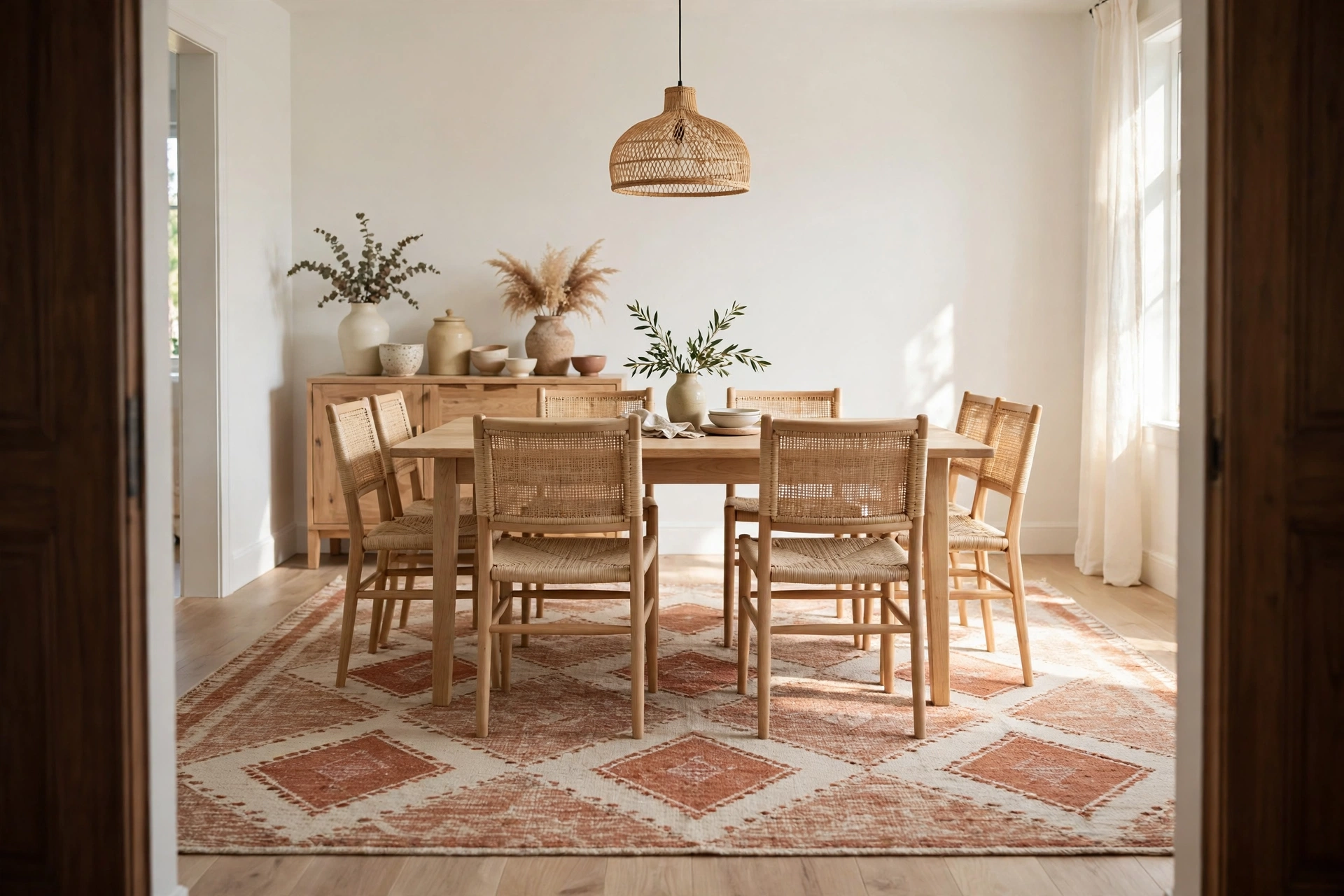
One practical warning from my own mistake file: keep the pile low in here. Deep pile under a dining table is a constant low-level fight. Chair legs snag in it, crumbs vanish into it for good, and sliding your chair in becomes a small workout three times a day. A flatweave, or the lowest pile you can find, is the dining room's friend, and it is far easier to shake out and clean when someone drops a forkful of something saucy. Someone always does.
Bedroom: under the lower two-thirds of the bed
The bedroom rug has a narrower job than the others. It is mostly for the first three seconds of the morning: you want your feet to land on something soft rather than cold floor, and you want the bed to look anchored to the room instead of parked in it. The arrangement that does both is the rug under the lower two-thirds of the bed. It starts roughly level with the bedside tables, runs under the foot of the bed, and sticks out on both sides and at the end. The bedside tables themselves stay on the bare floor, which suits their small legs and quietly saves you a band of rug size you would never see or step on.

Run it this way and the width does the talking: you want enough rug showing on each side that stepping out feels generous, not like balancing on a shelf edge. For most double and king beds, the middle and largest standard sizes are the ones that land here, and if you are between them, the tape test further down will settle it in a day. The cheaper alternative, and the one I lived with happily for years, is two runners, one down each side of the bed. Your feet still land somewhere kind, more of the floor shows, and two runners cost a good deal less than one very large rug. The runner trick only fails at the foot of the bed, so if yours has a bench, a trunk or a chair sitting at the end of it, the full rug earns its place back.
Hallways: a runner is a path, not a fitting
A hallway runner should look like a path laid through the hall, never like carpet that happens to stop. Leave a few centimetres of floor showing on both sides, a hand's width is the feel you are after, and never let the edges run right up to the skirting boards, where they read as a fitting error rather than a choice. Length matters just as much. A runner that ends a long way short of the hall looks lost and a bit apologetic, while one that creeps right up to a door threshold gets caught, folded and kicked by the door and by feet all day. Aim to cover the stretch of hall you actually walk, with a clear gap left at both ends.
Kitchens: runners where you stand, mats where it splashes
In the kitchen, forget anchoring furniture. A runner here runs along the worktop line where you genuinely stand and chop, and its job is to give your feet and your back a kinder long shift, and to catch the drips before the floor does. Keep the pile low and choose something washable, because it will be washed, often, and a kitchen runner that cannot survive the washing machine is a short-lived purchase. The other hard-working piece is a smaller mat at the sink, sized to the patch where you stand to wash up. A rug under a kitchen table is a dining rug wearing an apron; it follows the dining rules above, 60 cm and all.
Measure with tape on the floor, not numbers on paper
Here is how I measure now, after the bath mat incident taught me better. I outline the rug on the floor with painter's tape, at exactly the size I am thinking of buying, and then I live with the outline for a full day. I sit on the sofa. I pull the dining chairs out and sit at the table. I get out of bed on the wrong side, the way you do at half past six with your eyes half shut. The tape tells you within an hour what a tape measure on its own cannot: whether your feet land inside the line, whether the chairs stay on it, and whether the whole thing crowds anything.
Two checks people skip, and both are free. The first is doors: open every door that swings into the space and make sure it clears the floor where the rug will sit, and check any threshold strips the rug's edge would have to climb over, because an edge riding up on a threshold bar never lies flat again. The second is what you measure. Do not start with the room. Measure the furniture arrangement, the full span of the sofa and chairs as they actually stand, because that span decides the size. The room only sets the maximum you can get away with.
Torn between two sizes? Tape both outlines, one inside the other, and live with the pair for a day. Then buy the bigger one. I have never met anyone who regretted the larger rug, and I include myself, twice, in the list of people who regretted the smaller.
Underlay: the boring layer that does the safety work
Whatever size you land on, put something under it. On a hard floor, a rug with nothing beneath it walks, slowly and surely, towards the nearest wall, bunching as it goes, and the curled edge you keep catching your toe on is a genuine trip hazard. That matters most of all in a hall, and double near any stairs, where a sliding runner is an accident with a date on it. A basic non-slip underlay, or a gripper pad cut a couple of centimetres smaller than the rug so it hides underneath, holds the rug flat, stops the creep, and cushions the pile enough that the rug itself lasts longer. It is the least glamorous purchase in this whole post and the one I would cut last.
When a small rug is actually the right rug
Small rugs are not banned. They are just doing a different job, and the job decides the size. A doormat inside the front door is there to catch grit and wet, and it should be roughly the width of the doorway and deep enough to hold one full step. A bath mat is there for wet feet, and it should cover the patch where you step out of the bath or stand at the basin, and not much more. Notice what these two have in common: nobody is asking them to hold furniture together. A small rug only looks wrong when it is pretending to be an area rug, sitting under a seating group it cannot reach.
The mistakes I see most (and have made)
The postage-stamp rug
A rug so small it reads as a stamp stuck in the middle of the envelope: the towel-sized rug at the foot of a double bed, the little square marooned in a big sitting room. It anchors nothing, warms nothing, and mostly draws the eye to how much floor it failed to cover. If the budget will not stretch to the right size, the honest fixes are the two bedroom runners, or waiting and saving for the size the room needs.
The rug that only fits the coffee table
The living room special. The rug covers the coffee table's footprint beautifully and reaches nothing else, so the sofa and chairs stand on bare floor around it like spectators. The table was never the thing that needed anchoring. The seating is. Size the rug to the legs of the things people sit on, and let the table land wherever it lands, which will be in the middle, where it was going anyway.
Choosing the size by price alone
Rug prices jump sharply between standard sizes, so the smaller one always looks like the sensible saving in the shop. It is usually the most expensive saving you can make, because a wrong-sized rug is either replaced within a couple of years or lived with, slightly annoying you, every day until it is. The right size, kept for a decade, is the cheaper rug.
Forgetting doors and thresholds
The rug that fits the room perfectly and then fights the door. An edge that a door drags across will curl, fray and eventually fold under, and an edge pushed over a threshold strip never sits flat. Swing every door, check every threshold, and shave the plan down or shift the rug before the money is spent, not after.
So: anchor the furniture, give the dining chairs their 60 cm, let your feet land on the bedroom rug, and tape the outline before you spend anything. Do those four things and the pattern and colour can be whatever makes you happy. Tell me in the comments which room you are stuck on, and I will help you do the sum.
Questions I get asked about rug sizes
Can a rug be too big?
Yes, and it has a particular look: the rug touches the skirting boards, slides under every piece of furniture in the room, and stops reading as a rug at all. You have bought expensive carpet with extra steps. Keep the border of bare floor, roughly 20 to 45 cm in a living room, and a big rug stays a rug.
My room is small. Should I still go for a bigger rug?
Within reason, yes, because the instinct to match a small room with a small rug backfires. A bigger rug pulled under the front legs of the seating makes the seating area read as one generous zone, and the room feels larger. Go one standard size up from your first instinct, tape it out first, and keep the border of floor showing.
Do all four legs of the sofa have to be on the rug?
No. Front legs on is the working standard in most living rooms, and it anchors the group properly. All legs on is the upgrade for a large room or a sofa that floats in the middle of one. What does not work is no legs on, which is the floating island this whole post is trying to rescue you from.
How do I stop a rug sliding on a wooden floor?
With underlay, not tape. A non-slip underlay or gripper pad underneath, cut slightly smaller than the rug so it stays hidden, holds it flat and still. Avoid sticking adhesive tape directly to a varnished or oiled floor; it can lift the finish when it comes up, which is a much worse problem than a wandering rug.
Already know your room's awkward spot? Tape the outline this week and live with it for a day before you order anything. It costs one roll of painter's tape, and it has saved me more money than every sale I have ever shopped.
Lisa Ben
Lisa paints, builds, thrifts and rearranges her way through one very patient house, then writes down everything she learns here on Wazala. White paint is her favourite argument. New projects land every Tuesday, Thursday and Saturday, and the Sunday Letter rounds them up once a week.
You might also like
Small Living Room Layouts: 6 Arrangements For Tight Spaces
Six ways to arrange a small living room, with the walkway widths that make each one work.
Read more →
How To Hang A Gallery Wall Around The TV
Paper templates first, then the spacing that keeps a wall of frames looking calm, not cluttered.
Read more →
17 DIY Shelf Ideas For Every Room
Floating, bracketed, ladder and corner shelves, each with honest notes on weight and fixings.
Read more →