How To Stop A Door From Slamming In The Wind
 By Lisa Ben
·
October 30, 2026
·
12 min read
Our hallway door has a temper. The first breezy day of autumn, with the kitchen window open at the front of the house and the bathroom window open at the back, it lets rip: a bang loud enough to rattle the picture frames. Then again. And again. For a whole season I wedged a trainer under it, which worked until somebody needed the trainer.
A slamming door is not one problem, it is three different problems wearing the same coat. Each has its own fix, and the fixes run from pennies to a Saturday morning. Work out which problem you have first, then start at the cheap end. Most doors stop at step one or two.
Why doors slam in the first place
A door is a sail with hinges. Anything that pushes air through your house will swing it, and anything slightly off in how it hangs will swing it all by itself. Three usual culprits:
A cross-draught. Two openings line up: a window at the front of the house, a window or outside door at the back, and a clear run of hallway between them. Air pours through, and your door sits right in the stream. The pressure difference across it is small, but spread over a whole door's worth of panel it is plenty to slam it.
Pressure from fans and heating. No wind needed. A kitchen extractor on full blast or a bathroom fan can pull enough air through the house to drag a door shut. If your door slams on a perfectly still day, this is usually why.
A door that is hung out of level. If the frame leans even slightly, or the hinge side is not plumb, gravity does the rest: the door creeps open or shut on its own, slowly on a calm day, and with real enthusiasm when a draught helps it along. These are the ghost doors, and no doorstop cures them, because the problem is in the hang, not the air.
Work out which door you have
Two minutes of detective work saves you buying the wrong fix.
The still-day test. Close every window and outside door, turn the extractors off, then open the problem door halfway and let go. If it creeps one way or the other by itself, you have the out-of-level door: skip ahead to the hinge fixes. If it sits there politely, the door hangs fine and the air is your enemy.
The tissue test. Tape a strip of tissue paper so it hangs at the gap on the latch side of the door, close the door gently, then open the windows you normally open. If the tissue streams towards the gap, air is being pulled through that doorway. Open windows one at a time and you will find the exact pairing that powers the slam.
The last-centimetre test. Close the door slowly by hand. If it swings quietly and only bangs at the very end, the door is fine and the latch is the noise. There is a section for that further down.
Fix one: cushion the landing
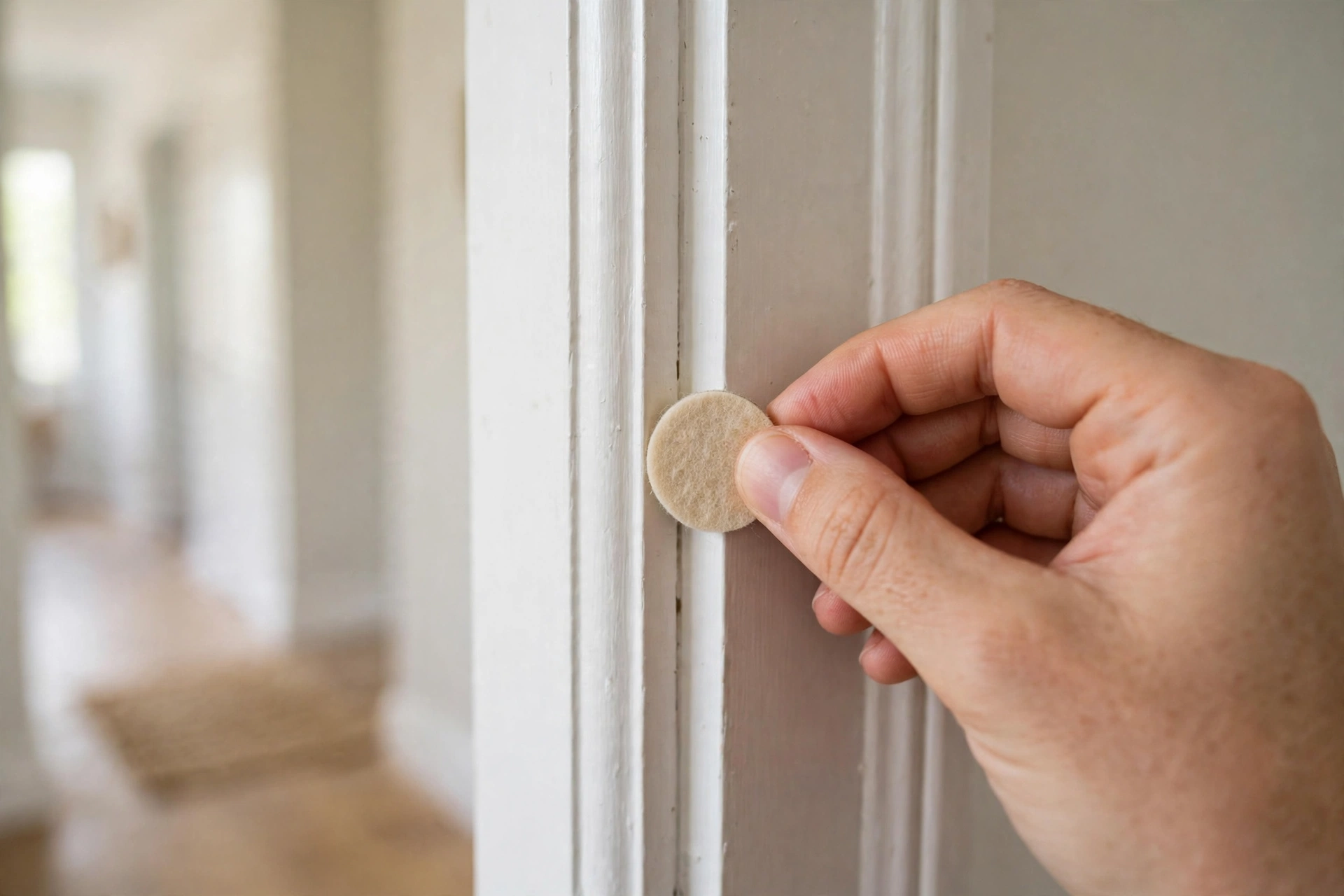
If the door has to close, and most bathroom and bedroom doors do, you can at least take the bang out of it. Stick small self-adhesive felt pads, the kind sold for chair legs, onto the frame exactly where the edge of the door lands: usually high on the latch side and near the top. Two or three thin pads are plenty. Keep them thin, because fat pads can hold the door just far enough out that the latch stops catching, and a quiet door that will not stay shut is worse than a loud one.
Foam weatherstrip, the draught tape sold for sealing windows, does the same job with a bonus: run it around the inside of the frame and the door meets foam instead of bare wood, which also kills the rattle and seals the whistle of wind round the edges. One caution: on a door that already fits snugly, weatherstrip on the latch side can make it stiff to close, so put it on the hinge side and along the head of the frame instead.
Honest note: this is the internet's favourite fix and it is not magic. Pads squash flat and peel off after a season or so, so keep the sheet in the junk drawer and treat replacements as a yearly two-minute job. Both are completely rental-friendly: peel, wipe the sticky spot, done.
Fix two: a doorstop that actually holds
Some doors slam the other way: the draught pushes them open, into the wall or the furniture. For those, the answer is holding the door where you want it. Not all stops are equal, and I have owned most of the disappointing kinds.
The wedge. Cheapest thing in the hardware shop, and on a hard floor a rubber wedge genuinely works: the draught pushes, the wedge grips, the door stays. On carpet it slides like a sledge, and the shiny plastic ones slide everywhere, so buy rubber, buy ugly, and accept that wedges wander off into the same dimension as odd socks.
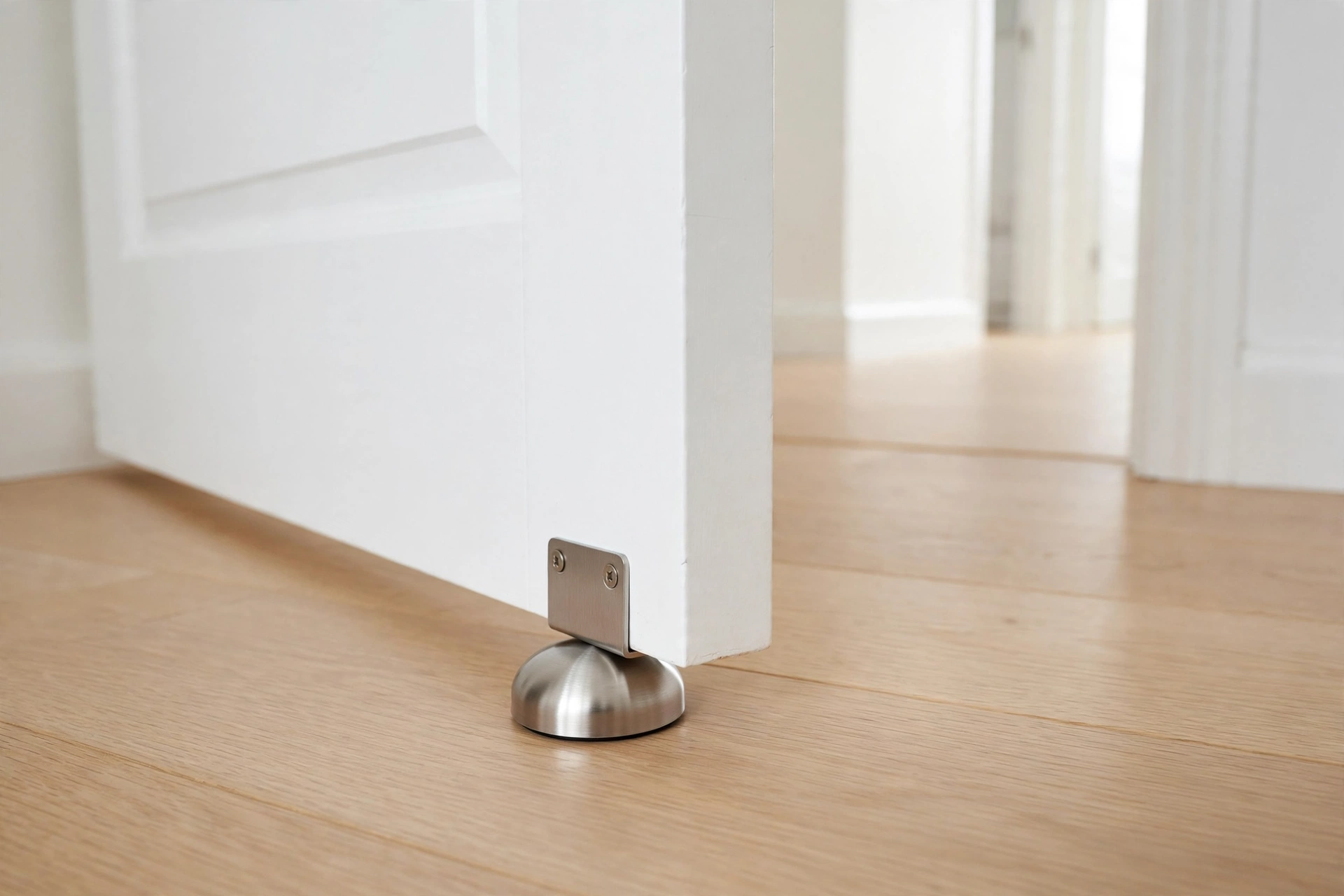
The magnetic stop. A small post screws to the floor or the skirting, a catch plate screws to the bottom of the door, and when the door swings back to it, click, it holds; a firm tug releases it. This is the one I fitted in the end, because it holds against a real draught and still lets go with a pull. It needs screws, so landlords should be asked, but the holes are tiny and in the skirting.
The hinge-pin stop. This little thing sits over the hinge pin and limits how far the door can open, so it can never reach the wall. Two minutes to fit, no new holes. Be clear about what it does, though: it stops a door banging open, and does nothing at all for one that slams shut. On a lightweight hollow door it can also dent the door edge over months, so check it now and then. As for the cute fabric doorstop full of sand: on a smooth floor a determined draught drags it across the room like a tiny anchor that gave up. Fine as a prop, useless as a brake.
Fix three: give the hinges some friction
For the ghost door, you want drag in the hinges. Start with the screws: loose hinge screws let a door drop and wander, so drive every screw snug and see if the swing calms down. If a screw spins, the hole has stripped. A longer screw in the top hinge can reach through the frame into the stud behind and pull everything back into line, which fixes more creepy doors than any product on this page.
Then the old joiner's trick: a slightly bent hinge pin. A pin bowed by a whisper drags inside the hinge barrel, and that friction slows the whole swing, so a draught has to work much harder to slam anything. Here is how to do it safely.
- Close the door and keep it closed. You are taking one pin out of three hinges; the other two hold the door perfectly well.
- Tap the pin up from underneath with a screwdriver and hammer, then pull it out with pliers.
- Lay the pin on concrete or a solid block and give it one gentle tap in the middle. You want a bow so slight you have to look twice to see it. A banana-shaped pin will not go back in.
- Slide the pin home. It should need a few taps to seat (that resistance is the whole point), then test the door.
Do the middle hinge first, test, and only bend a second pin if the door still swings too freely. Never bend a pin with the door's weight hanging through that hinge while you work, and never take two pins out at once unless the door is supported. Doors are heavier than they look.
Fix four: a proper closer, set up properly
Some doors must close themselves: the one to the garage, a front door, anything with a fire rating. For those, an overhead door closer is the real answer, because it does not stop the door closing, it controls the speed of every centimetre. And most slamming closers are not broken, just badly adjusted.
Fitting one from scratch is a morning's job: tape the paper template from the box to the door, drill pilot holes, screw the body to the door and the arm to the frame, into solid wood. The clever bit is the two little valves on the closer body, marked 1 and 2, or S and L.
- Sweep (S, or 1) sets the speed of the main swing, from fully open down to the last 15 centimetres or so.
- Latch (L, or 2) sets the speed of those last few centimetres, the part that clicks the door shut. This is the valve your bang lives in. Latch set too fast is a slam, every single time.
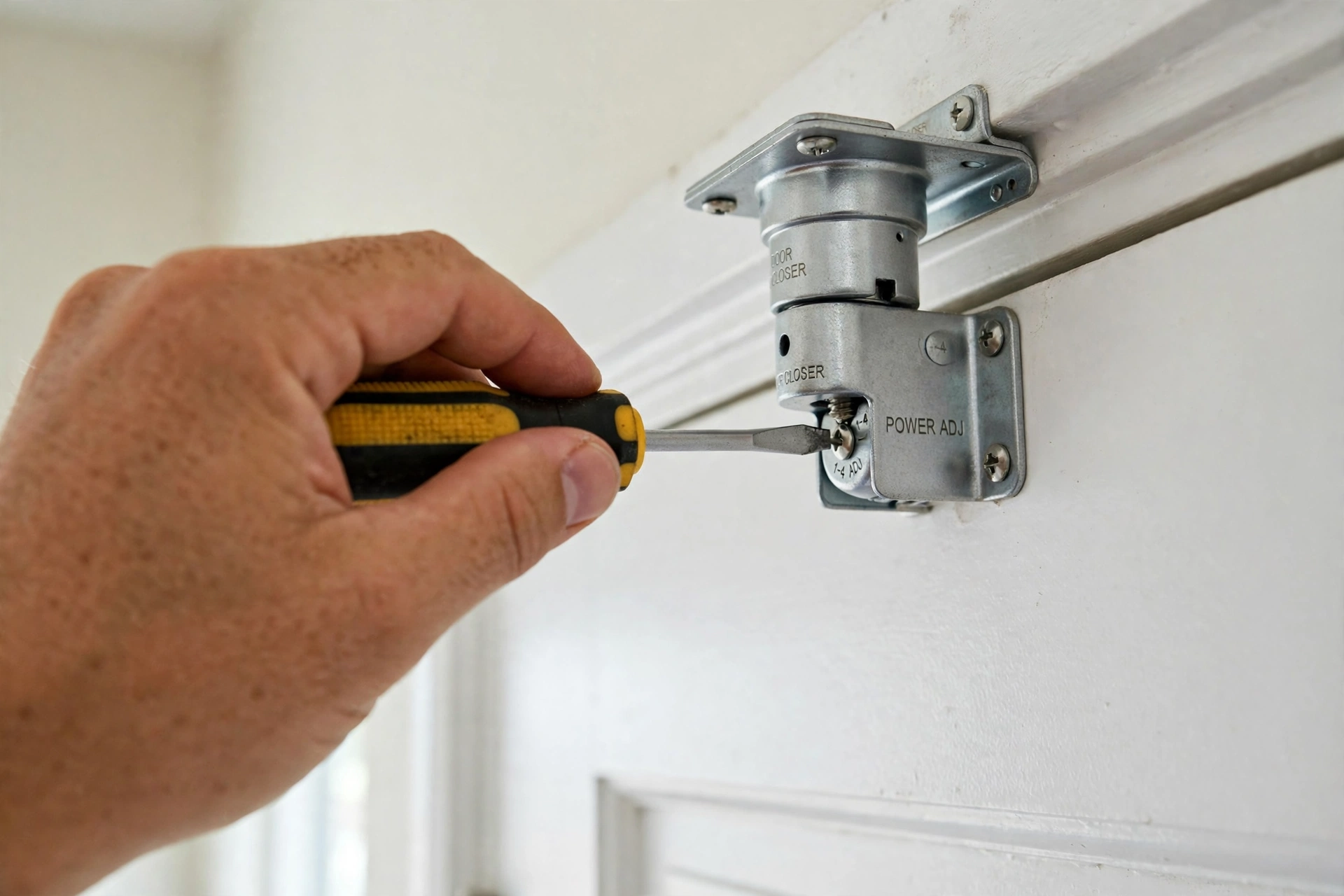
Turn a valve a quarter turn at a time, clockwise to slow the door down, then open the door fully and watch it close before touching anything again. Aim for five or six seconds end to end, finishing in a click, not a thud. Two warnings: never unscrew a valve all the way out, because the oil escapes and the closer is scrap; and if oil is already weeping from it, adjustment will not save it. That one needs replacing.
When the bang is the latch, not the door
Some doors swing like angels and then, crack, at the very last moment. That is the latch bolt hitting the strike plate edge-on instead of sliding into its hole, usually because the door has shifted a couple of millimetres over the years. To prove it, smear a little chalk on the end of the bolt, close the door, and open it again: the mark shows exactly where the bolt strikes.
The fixes are all small. The strike plate has a little bent tab inside its hole; bending it out slightly with pliers guides the bolt in earlier and softens the meeting. The plate can be nudged a couple of millimetres sideways, with the old screw holes packed with matchsticks and glue so the screws bite. If you are replacing the latch anyway, look for a soft-close or whisper latch, which has a nylon piece on the bolt that meets the plate quietly. On doors that never needed to latch, like cupboards, a roller catch removes the bolt from the story completely.
Fix the draught at the source
Sometimes the cheapest fix is one room away. If the slam only happens when the kitchen window is flung wide, leaving that window on its night latch instead breaks the wind tunnel: the draught needs an entrance and an exit, and it sulks when it cannot have both. A brush strip or door sweep along the bottom of the door helps too, killing the under-door gap the air rushes through and adding a whisper of drag. And closing one quiet door mid-house changes the path the air takes, which is sometimes the whole job done for free.
Small fingers, big doors
A slamming door is a nuisance. On small fingers it is a trip to A&E, and the dangerous gap is not the latch side everyone watches, it is the hinge side. As a door closes, that gap narrows to a point, and it is exactly where toddlers put their fingers while holding the frame to steady themselves.
Finger guards solve it for a few pounds: a flexible strip that covers the hinge-side gap and concertinas as the door moves, so no small hand reaches the pinch point. Fit one on any slamming door in a house with children under five. Foam clips that hook over the top edge of the door, so it can never fully close, earn their keep in the toddler years too, and pet owners swear by the same trick for the opposite reason: a door that cannot latch shut cannot shut the cat in the spare room. Or out of it.
Mistakes I have made, or nearly
Oiling the hinges to fix a slam. Oil is for squeaks. A squeak is too much friction and a slam is too little, so oiling a slamming door makes it bang harder. Ask me how I know.
Bending the pin while the door hangs on it. Take a pin out of a loaded hinge with the door unsupported and the door drops and twists the remaining hinges. One pin at a time, door closed and supported.
Pads so thick the door stops latching. Then you start slamming it by hand to make it catch, and the slam is now manual and all yours.
Cranking both closer valves fully shut. The door takes twenty seconds to close, everyone pushes it, and the arm takes the strain. Quarter turns. Test. Patience.
Buying the prettiest doorstop. You are shopping for weight and grip, not looks. A brass wedge that slides across the floor is jewellery at that point.
Questions I get asked about slamming doors
Will felt pads wreck my paint when I peel them off?
Very unlikely. Warm the pad with a hairdryer for twenty seconds, peel slowly, and any residue comes off with a dab of cooking oil on a cloth. On old, flaky paint the paint was leaving anyway; the pad just takes a flake with it.
My door slams with every window shut. What is going on?
Two suspects: the door hangs out of level and gravity swings it, or an extractor fan is pulling air through the house. Run the still-day test with the fans off, then on. Hinge friction handles the first; the second usually calms down with pads and a sweep, since the pull is gentler than real wind.
Can I stop a door slamming with no drilling and no tools?
Mostly, yes. A rubber wedge for a door that bangs open, felt pads and foam weatherstrip for one that bangs shut, and a foam clip over the top to hold it ajar. That covers most rented flats. The bent pin needs a hammer and pliers, and the magnetic stop needs a screwdriver, so those two wait for a landlord's blessing.
Can a beginner fit a door closer?
Yes, with the template in the box and a free morning. The fitting is simple screw work; the skill is in the adjusting afterwards, and that is five patient minutes with a screwdriver. If the closer is going on a fire door, though, leave it to a professional. Fire doors are not the place to learn.
So the order is: test first, then pads, then a stop that holds, then friction in the hinges, and a closer only for the doors that truly need one. Our hallway door now closes like it has manners, and the trainer is back on the shoe rack. Tell me in the comments which of the three doors you have got, the draughty one, the ghost, or the latch banger, and I will tell you where I would start.
Lisa Ben
Lisa paints, builds, thrifts and rearranges her way through one very patient house, then writes down everything she learns here on Wazala. A quiet house is her favourite sound. New projects land every Tuesday, Thursday and Saturday, and the Sunday Letter rounds them up once a week.