A Simple Tablescape Formula For Dinner Guests
 By Lisa Ben
·
October 11, 2026
·
11 min read
The food is the easy part of having people over. It is the table that used to undo me. Guests would be twenty minutes away and I would be standing in the dining room holding a candlestick in each hand, wondering where everyone was supposed to put their elbows.
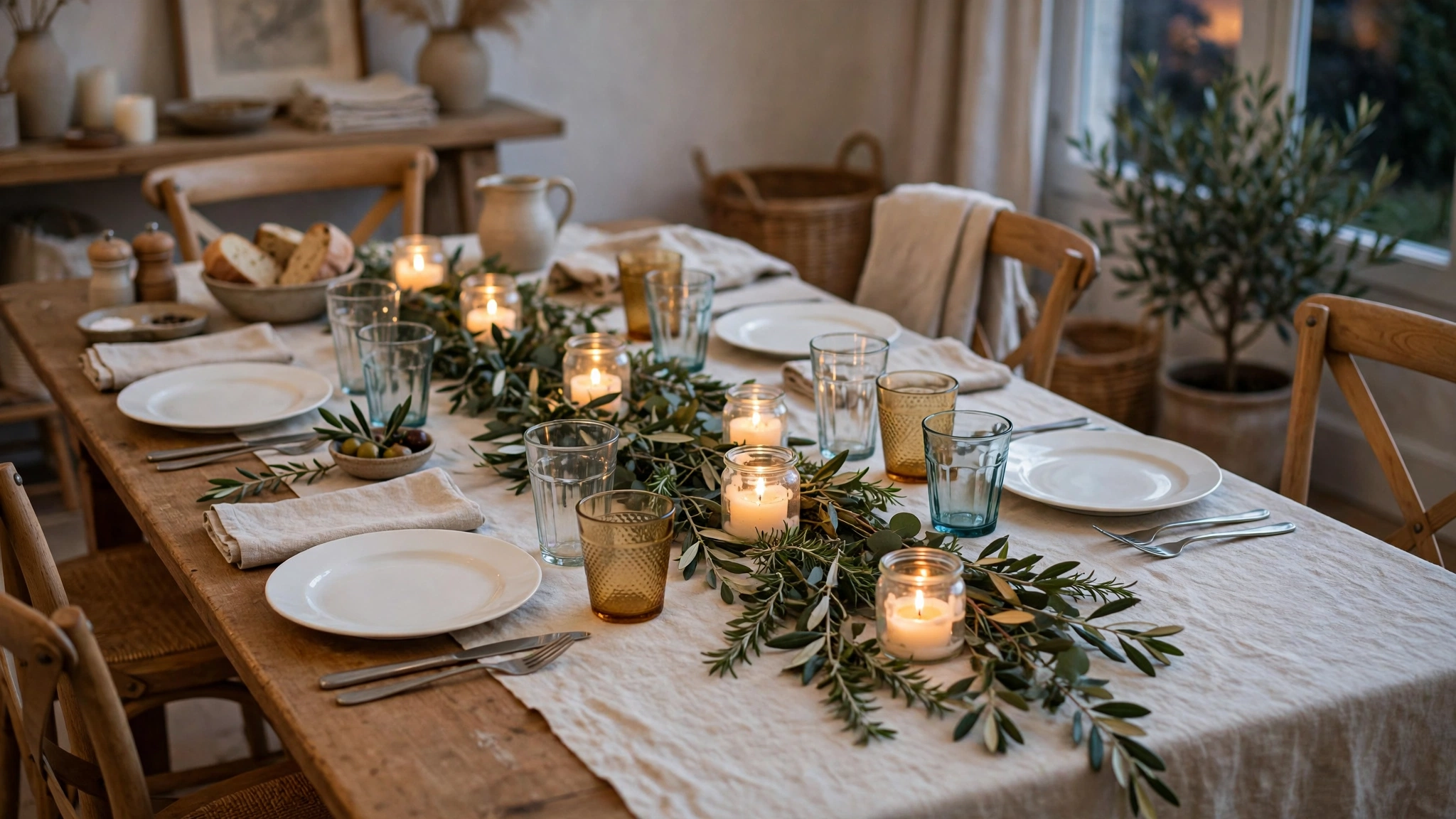
What fixed it was not buying anything. It was giving myself a formula. Five parts, in the same order every time, built out of things already in my cupboards: a cloth, something low in the middle, candles, a setting that makes sense, and one small personal touch. I use it for a Tuesday supper with neighbours and I use it at Christmas, and the table looks deliberate both times. Here it is, part by part.
The formula, before we start
- A base layer — a cloth or a runner.
- Something low in the middle — greenery, jars, fruit. Nothing tall.
- Light at table level — unscented candles, in odd numbers.
- A setting that works — plates, one set of cutlery, glasses where hands actually reach.
- One personal touch — one. Not five.
That is the whole system. Everything below is why each part earns its place, and where I have gone wrong with it so you do not have to.
Part one: the base layer
A cloth does three jobs at once. It hides a tired or marked table, it softens the clink of plates and glasses so the room feels calmer, and it gives everything on top a background to sit against. If your table is beautiful bare wood, skip the full cloth and run a runner down the middle instead. The layer matters more than which version you pick.
One honest warning: iron it. A creased cloth undoes the whole thing, because a crease reads as "I gave up halfway". I iron mine the night before and roll it loosely over the back of a chair rather than folding it, which keeps most of the creases out. Plain cotton or linen in a quiet colour is all you need, and washable is not optional. Gravy happens. Wine happens. A cloth you are precious about makes you a nervous host, and nervous hosts do not enjoy their own dinners.
Part two: something low in the middle
This is the part everyone gets wrong, because tall arrangements photograph beautifully and work terribly in real life. Put anything tall in the middle of a table and your guests spend the evening talking around it like a hedge, leaning left and right to find each other. Dinner is conversation with food attached. Never block the conversation.
So my rule is the sightline rule: nothing in the middle stands taller than about a fist above the plates. Test it properly. Sit in an actual chair at your own table and look across. If you cannot see the eyes of the person opposite, it is too tall, whatever the magazines say.
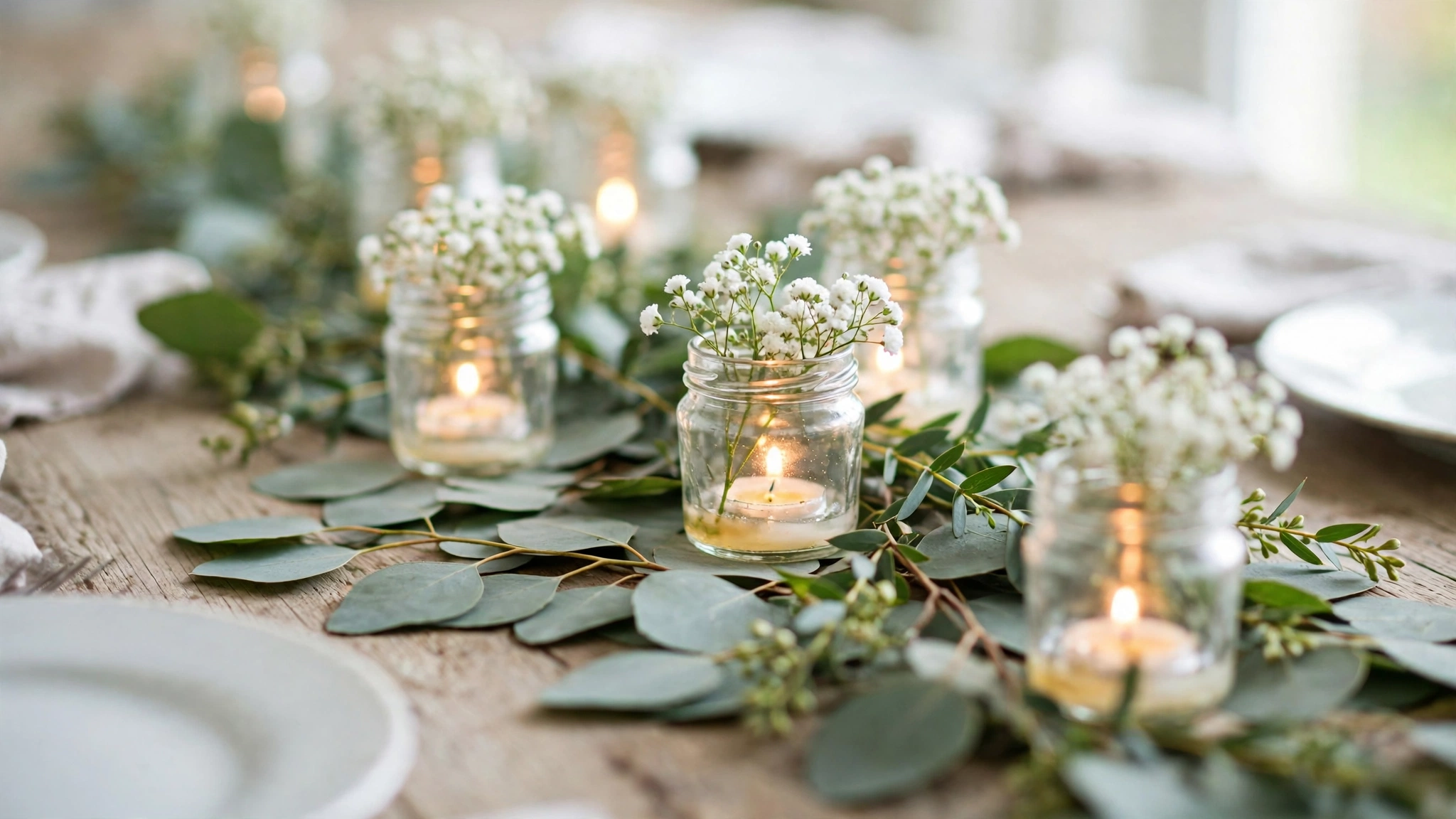
Low things that work: greenery laid flat along the middle, eucalyptus or olive or rosemary cut from the garden. A row of small jam jars holding whatever is flowering. A bread board with apples, pears or lemons piled on it, which doubles as pudding if the evening runs long.
Part three: light at table level
Overhead lights are not kind. They dig shadows into faces and leave everyone looking like they are being interviewed. Candles at table height do the opposite, and they are the cheapest atmosphere you can buy. Group them in odd numbers, three or five tea lights along the middle. Odd groups look deliberate. Pairs tend to look like leftovers from something else.
Keep them unscented at the table. I will say this plainly, because it ruins more dinners than burnt potatoes: a scented candle fights the food, and the food loses. A vanilla candle layered over roast chicken is a strange meal. Save the scented ones for the hallway, where they can greet people at the door instead.
Tea lights in jam jars are my standard version. The glass shields the flame from draughts and passing sleeves, and the jar catches the wax. Keep a hand's width between any flame and the greenery, because dried leaves and open flames are not friends. And the safety line that is not negotiable in my house: candles get blown out when the table empties for the night. Never leave them burning in a room nobody is sitting in, and never within reach of a curtain hem.
Part four: the setting itself
Plate in front of each chair, knife on the right, fork on the left, napkin on the plate or under the fork. Nobody is marking you, and anyone who is should not be invited back. One set of cutlery covers most dinners honestly. If dessert needs a spoon, the spoon can arrive with the dessert.
The one rule I actually care about is the glasses rule: put the water glass where the hand actually reaches, up and to the right of the plate, and set fewer glasses than you think. Every extra glass on a laid table is a future knock-over, waiting for the bread board to start travelling. Pouring wine? One wine glass beside the water. Nobody drinking wine? Set no wine glasses at all. An empty glass is not decoration. It is washing up you volunteered for.
And leave breathing room. If everything does not fit with elbow room to spare, shrink the centrepiece, not the guests.
Part five: one personal touch
The last part is the smallest. One thing that says you thought about the actual people coming. A name scribbled on a luggage tag, or on a big bay leaf, at each place. A sprig of rosemary laid on the napkins. The good butter in a little dish instead of the tub with knife marks in it.
One touch reads as thoughtful. Five touches read as panic, and they eat the hour you should spend on the food, or on sitting down for ten minutes before the doorbell goes. Pick the touch that takes two minutes and stop there. Mine, most of the time, is the names on leaves, because it also settles the where-do-I-sit shuffle before it starts.
The order I lay it in
The order matters: cloth first, then the centre, then the candles, then the settings, then the touch. Working from the middle outwards means you are never reaching across a finished setting, and the candles land exactly where the gaps are.
Timing is the other half of it. Set the table in the morning, or the night before once supper is cleared. The table is the one hosting job that can be completely finished early, and walking past a finished table all afternoon makes the cooking feel half done. Light the candles five minutes before people sit down, not when they arrive. They will still be going strong at pudding, and nobody has been alone with them in the meantime.
My shortcut: set one place completely, then sit in it. Check three things. Can I see the face opposite? Can I reach my water without standing? Is there room for my plate and the dish that is coming? Fix that one seat and the rest of the table just copies it.
The same formula, three seasons
The five parts never change. Only the middle strip and the colours do, which is why this costs almost nothing to run all year.
Spring
Jars of whatever is flowering: daffodils, tulips, a few snips of blossom from the garden if you have it. A pale cloth, light candles, and the table feels like the season without a single themed purchase. If it is near Easter, a bowl of eggs down the middle does the centrepiece job and gets eaten later.
Autumn
Swap the full cloth for a runner so the warm wood shows. Small pumpkins or gourds in a line, or a row of apples if the pumpkins feel like a costume. Amber or smoky glasses if you own them. The candles start doing more of the work now, because the light goes early and the table knows it.
Christmas
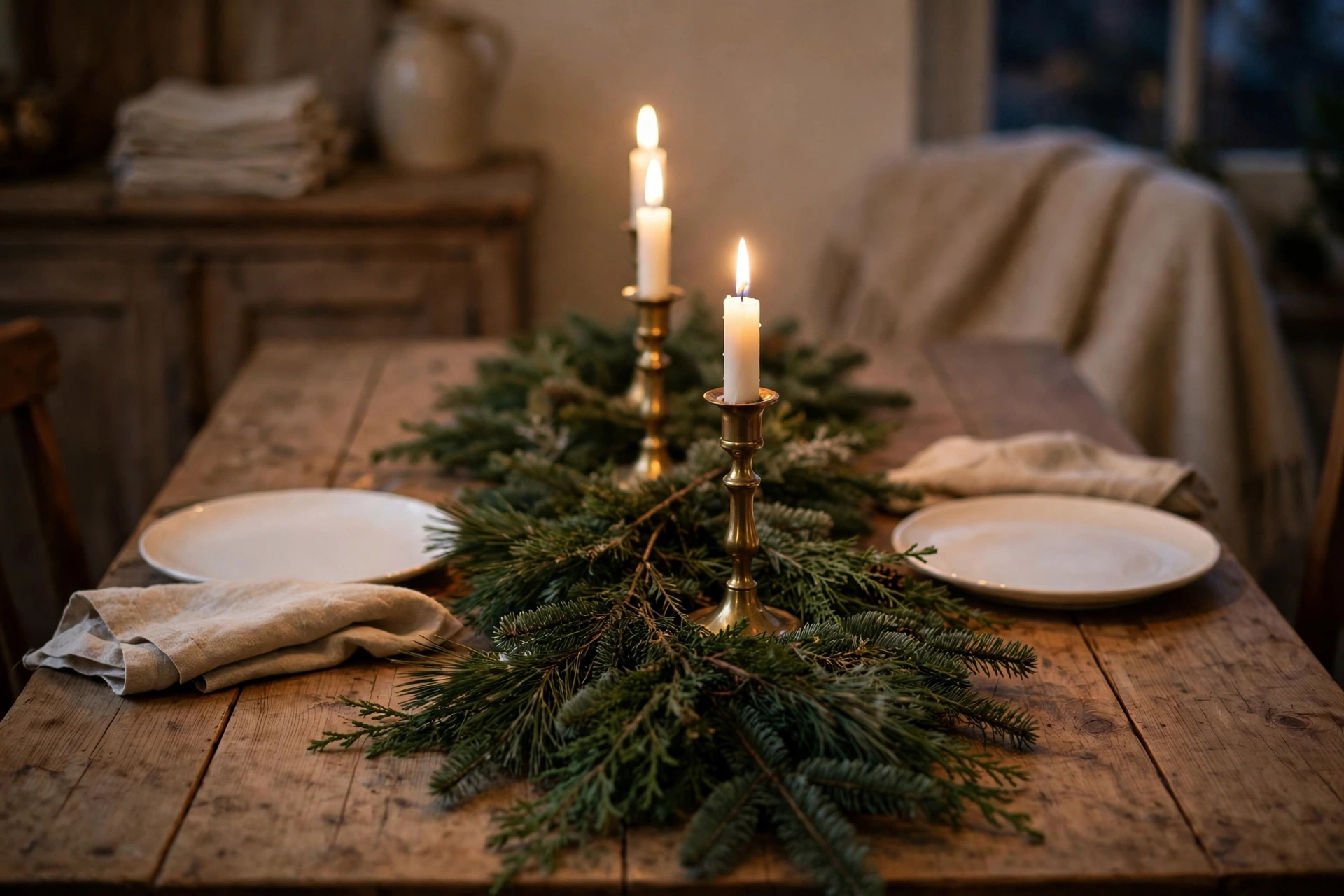
Evergreen laid flat, the offcuts from the tree if you have one, candles as usual, and exactly one metallic thing. Brass candlesticks, or gold-rimmed glasses, or a metal charger under each plate. One, not all three plus tinsel. The restraint is what makes it look expensive. If you want red, keep it to the napkins and let the green and the candlelight do the rest.
Small table? Serve from somewhere else
If your table is small, the honest fix is not a cleverer centrepiece. It is moving the food. Serve from the kitchen counter or a sideboard, and let guests pass plates to be filled there. Serving dishes parked on an already small table mean every elbow knocks a glass and every reach crosses a candle.
A calm table with food arriving in rounds beats a groaning table nobody can move at. Keep the five parts, shrink the middle to one narrow row of jars, and let only the dishes move house.
What to skip buying
You do not need a matching set of anything. Plain white plates and odd glasses are the house style of every good cook I know, and the calm cloth underneath is what makes them look chosen rather than leftover. Skip charger plates, the plate whose only job is to sit under another plate and then get washed and stored. Skip single-use themed decorations that will be in the bin by January. And skip anything sold as a tablescape kit, which is a box of the jars and tea lights you already own, wearing a label.
If money is burning a hole, spend it once on cloth napkins you like touching and a bulk bag of plain tea lights. Both get used for a decade. Everything else on the table can be borrowed from your own shelves.
Mistakes I have made, so you do not have to
- The tall centrepiece. Lilies at eye height, one spring dinner. We talked through leaves all night and two guests left with pollen on their sleeves.
- The scented candle. A cinnamon candle against a roast chicken. The candle won. The dinner lost. Unscented at the table, always.
- Setting at the last minute. Guests at the door, me ironing a cloth with wet hair. The table is now set the night before, non-negotiable.
- Borrowed chairs at the wrong height. Two chairs borrowed from a neighbour sat so low that guests ate at chin height, arms pinned. Test borrowed chairs against the table first, and put a firm cushion on any that sit low.
Questions I get asked about setting a table
Do the plates and glasses have to match?
No. Keep the plates roughly one size and colour family and nobody will notice the rest. Odd glasses look collected rather than careless as long as the cloth and the middle are calm, because the eye reads the table as one picture, not a stock check.
What if I do not own a tablecloth?
Use a runner, a folded flat sheet, or a clean throw down the middle. On a polished table a runner alone does the whole job. The base layer is about softness and background, not formality, so anything washable and flat counts.
How does the formula work for a big group at two tables?
Run the same five parts on both tables, with the same cloth colour on each. The centres can differ slightly, a jar more here, a board there, and the matching candles tie the two tables together into one party.
When should I light the candles?
Five minutes before everyone sits down. A tea light burns happily for hours, so there is no need to light them when the doorbell goes, and lit candles should never be left alone in an empty room while you answer the door and take coats.
Cloth, low middle, candles, a setting that works, one kind touch. That is the whole of it, and it has never once let me down. Tell me in the comments what your table struggles with, too small, too dark, chairs from three different decades, and I will tell you which two parts of the formula I would lean on hardest.
Lisa Ben
Lisa paints, builds, thrifts and rearranges her way through one very patient house, then writes down everything she learns here on Wazala. White paint is her favourite argument. New projects land every Tuesday, Thursday and Saturday, and the Sunday Letter rounds them up once a week.
You might also like
9 Christmas Mantel Ideas From Plain To Full-On Festive
Nine ways to dress the same mantel, from a quiet five minutes with greenery and candles to the full garland and stockings version. Pick your level of festive.
Read more →
How To Make A Wreath For Any Season
One plain wreath base, remade for every season with whatever is growing outside. The wiring order, the layering, and how I hang it without marking the door.
Read more →
How To Hang A Gallery Wall Around The TV
The measuring, spacing and hanging order for a gallery wall that works around the biggest thing on it.
Read more →