The Weekly Cleaning Schedule That Keeps A House Caught Up
 By Lisa Ben
·
October 14, 2026
·
10 min read

For years my cleaning system was called "panic when someone is coming over." The house would drift for two weeks, then I would lose an entire Saturday to a furious blitz, collapse on the sofa, and drift again. It worked, in the sense that the house was sometimes clean. It just cost me a weekend day and a lot of low-level guilt in between.
The schedule below is what replaced that, and I will be honest about what it is: a routine for a normal house lived in by normal people, not a show-home system. Nothing on it takes longer than about forty minutes. Some weeks I miss a day. The house survives, and so does the routine, because it was built with missed days in mind. Here is how it works, in two layers.
Layer one: the ten daily minutes that stop the mess forming
The weekly plan only works because of this layer. Most of what makes a house feel dirty is not dirt at all. It is yesterday's stuff still sitting where it landed. Four small habits, done most days, keep the pile from ever forming, and together they take about ten minutes:
- The sink ends the day empty. Dinner dishes go in the dishwasher or get washed the same evening. Waking up to a full sink makes the whole kitchen feel behind before you have even made tea.
- Laundry runs on a rhythm, not a crisis. In our house that means a load on set days, washed, dried and put away the same day. One finished load beats a mountain of washing that needs a free afternoon and a small crane.
- The entryway has a drop zone. One tray or basket by the door for keys, post and the random things that arrive in pockets. Clutter that has an official home stops spreading across every surface in the house.
- The bathroom sink gets a thirty-second wipe. Toothpaste splashes and hair take seconds to remove while they are fresh. Left for a week, they set like cement and the job becomes a scrub.
None of these is cleaning, exactly. They are tidying with a cloth nearby. But they are the reason the weekly jobs below stay small: Friday's bedroom clean is easy when there is no laundry landslide waiting in it.
Layer two: one job a day, Monday to Sunday
Each weekday gets one proper job, sized to fit a real evening or a lunch break. This is the version pinned inside my kitchen cupboard. Yours does not need to match it, and I will say this plainly because it matters: move the days around to fit your life. Work late on Wednesdays? Swap floors with Thursday. Clean better on weekend mornings? Slide the whole week. The days are a rack to hang jobs on, not a law.
| Day | Job | Rough minutes |
|---|---|---|
| Monday | Bathrooms: sinks, mirrors, loos, a quick scrub round the bath or shower | 30 |
| Tuesday | Kitchen deep bits: hob, microwave, the bin, plus one shelf, drawer or appliance | 25 |
| Wednesday | Floors: vacuum everywhere, mop the hard floors | 40 |
| Thursday | Dusting and glass: surfaces, picture frames, mirrors, the inside of the front windows | 25 |
| Friday | Bedrooms: change the bedding, surfaces, any laundry still loitering | 30 |
| Saturday | Entryway and fridge: clear out the fridge, wipe the shelves, sort the shoe and coat pile | 20 |
| Sunday | Mostly off. One 15-minute whole-house reset with a basket, nothing more | 15 |
Add it up and the planned cleaning comes to just over three hours a week, plus the ten daily minutes. I am not going to pretend that is nothing, because it is not. But compare it honestly with the alternative most of us actually live: a five-hour weekend blitz every fortnight, with a messy house for the ten days in between. The total time is similar. The difference is that the house now looks decent on a random Tuesday, which is when life mostly happens.
The Sunday reset deserves its own word, because it is the bit people skip and then wonder why Monday feels chaotic. Take a laundry basket, walk through every room, and put back everything that is out of place. Fifteen minutes, timer on, no scrubbing anything. You are not cleaning. You are handing Monday morning a tidy starting line.
The monthly and quarterly jobs, written down so they stop being surprises
The jobs that ambush people are the ones with no fixed home: the oven, the inside windows, the gunk behind the fridge. They are never urgent until a guest opens the oven door. Giving them a list of their own, checked once a month and once a quarter, turns them from emergencies into errands.
Once a month, roughly:
- Wipe down kitchen cabinet fronts and handles, where the grease film builds up invisibly
- Clean the washing machine drawer and check its filter
- Descale the shower head, or wash the shower curtain and liner
- Dust skirting boards and the tops of door frames
- Give the inside of the main windows a proper clean, not Thursday's quick pass
Once a quarter, roughly:
- A full oven clean, the gloves-and-patience kind
- Pull the fridge and cooker out and clean behind and under them
- Wash or replace the extractor fan filters
- Descale the kettle, and empty and clean the vacuum's filters so it keeps its suction
- Vacuum the mattresses and turn them if yours needs turning
I do not do all of a month's list in one heroic session. One job gets attached to whichever weekly day is lightest that week, usually Tuesday. That is it. The list lives on the same cupboard door as the weekly one, and jobs get ticked off in pencil, because this is a house, not an audit.
The rules that make it stick
A schedule is just a list. These four rules are what turn the list into something still running six months later.
Set a timer. Every job on the plan has a time attached, and when the timer goes off, the job is done, even if it is not perfect. This sounds like a trick and it is, but it works on the part of your brain that would otherwise avoid starting the bathroom at all because "it takes forever." It does not take forever. It takes thirty minutes, and the timer can prove it.
Work top to bottom. Dust before you vacuum, surfaces before floors, always. Gravity is on the cleaning schedule too, and anything you knock off a shelf lands on the floor you just mopped if you do it the other way round. It also gives each job a natural order, which makes it faster the second week than the first.
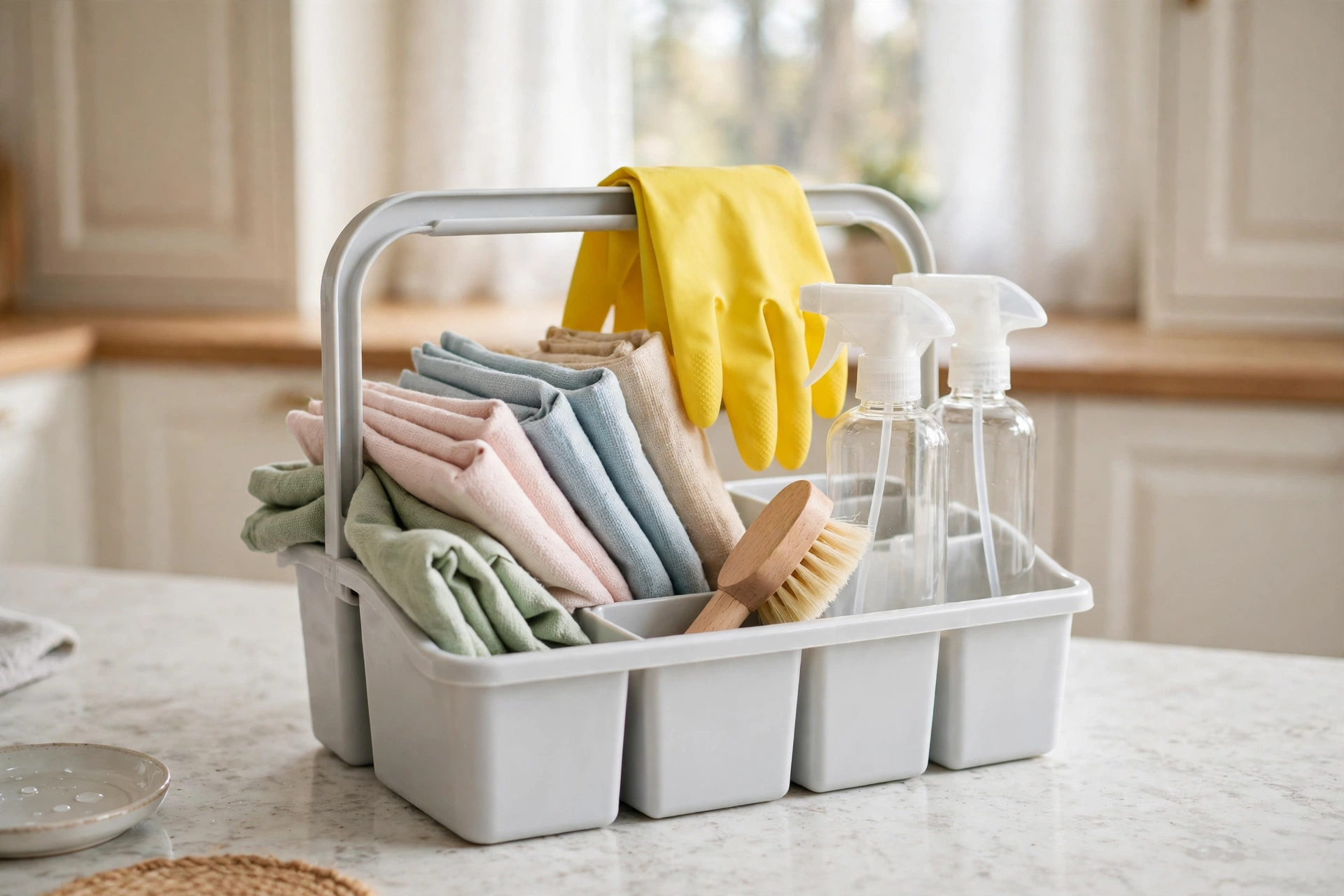
Carry a caddy. One caddy with cloths, a general spray, a bathroom spray, a brush and gloves, living in one cupboard. Half the reason small jobs balloon is the six trips to fetch and return supplies. The caddy kills the trips, and it is the whole reason my kit is photographed above instead of spread across three cupboards.
A missed day rolls once, then waits. This is the rule that saved the whole system for me. If Thursday's dusting does not happen, it can move to Friday. If it misses Friday too, it does not get doubled up or squeezed into the weekend. It simply waits for next Thursday. Nothing in a normal house gets dangerously dusty in a fortnight, and the moment the schedule starts punishing you for a busy week, you will quietly quit it. I did, twice, before I added this rule.
My starting advice: do not begin with the whole plan on Monday. Run just the daily ten minutes for the first week, add two weekday jobs the week after, and let the rest slot in over a month. A routine that grows slowly tends to be the one still standing in spring.
Sharing the load without the weekly argument
If more than one person lives in the house, the schedule should not live in one person's head. In ours, jobs get picked by preference, not by any rule about who "should" do what. I genuinely do not mind bathrooms and would happily never mop a floor again; the floors are not mine, the bathrooms are, and we are both better off than when we split every job down the middle and each resented our half. Let whoever hates a job least own it, swap the ones nobody wants month about, and write the split on the same cupboard door as the schedule, where it is a fact and not a debate.
Kids can carry real pieces of this too, sized to their age. Small ones can ferry toys back to their room in the Sunday basket and wipe the table after tea with their own cloth, which most of them treat as a promotion. Primary-age children can dust the low shelves, pair socks from the laundry load, and keep their own floor clear enough to vacuum. Older ones can take a whole day-job in miniature: their bathroom sink, their bedroom on a Friday, the bins on a Saturday. The point is not free labour. It is that the schedule belongs to the house, not to one exhausted project manager.
Where cleaning schedules usually fall apart
The weekend marathon. Saving everything for Saturday feels efficient and is the fastest route to hating your own system. Weekend cleaning expands to fill the day, guests or not, and within a month the schedule is just a description of your Saturdays. The whole point of the weekday jobs is that the weekend stays yours, apart from twenty minutes by the fridge.
The perfection standard. A schedule built on "properly clean" will fail, because properly clean has no finish line. Thursday dusting means the visible surfaces, not the top of the wardrobe. Monday bathrooms means the sink, mirror and loo shine, not regrouting. Done to the timer beats done to a standard nobody can see, every single week.
Buying products before there is a system. I say this as someone whose under-sink cupboard once held nine sprays. A new bottle feels like progress and changes nothing. Two sprays, two cloths and a brush cover every job on this page. Get the routine running first; if a specific job truly defeats the basic kit, that is the time to buy the specific thing, and you will know exactly why you are buying it.
Questions I get asked about the cleaning schedule
I work full time. Is this realistic on weekday evenings?
It is the version I run, and I am not a morning person, so the jobs happen in the evening in whatever order the day allows. On a genuinely long day, do the fifteen-minute version: bathrooms become just the sink and loo, floors become just the rooms people walk through. A small version done counts. The schedule bends so it does not break.
What happens when I miss a whole week, like a holiday or a flu?
Nothing dramatic, and do not try to catch up. Restart on whatever day it is, with that day's job, and let the missed jobs come round again naturally. The monthly list absorbs anything that truly cannot wait. A house that was mostly clean last week does not fall apart in seven days, whatever the guilt says.
Do I need a lot of special products to follow this?
No. The honest kit is an all-purpose spray, a bathroom spray, washing-up liquid, two or three microfibre cloths, a scrub brush, a duster, and the vacuum and mop you already own. Everything on the weekly plan can be done with that. Specialised products earn their place only when a specific job proves you need one.
How long before it starts to feel automatic?
About a month for most people, me included. The first two weeks feel like effort because you are checking the list and hunting for the caddy. By week four the days have a feel to them, Wednesday smells like floor cleaner without you deciding anything, and the list becomes a backup instead of a driver.
That is the whole system: ten minutes a day to stop the mess forming, one job a day so nothing ever gets big, and a written home for the rare jobs so they stop ambushing you. Start smaller than you think you should, move the days until they fit your actual life, and let the odd missed Thursday go without a speech. Tell me in the comments which day of my week you would move first in your house, because no two households ever keep the same order.
Lisa Ben
Lisa paints, builds, thrifts and rearranges her way through one very patient house, then writes down everything she learns here on Wazala. The cleaning schedule above is pinned inside her kitchen cupboard door, in pencil. New projects land every Tuesday, Thursday and Saturday, and the Sunday Letter rounds them up once a week.
You might also like
How To Organize A Small Pantry When The Shelves Are Too Deep
Deep shelves swallow tins whole. Bins, risers and a ruthless edit bring them back.
Read more →
Small Closet, Sorted: The Two-Hour Edit
One rail, one honest afternoon: what stays, what goes, and the hanger trick that doubles the space.
Read more →
17 DIY Shelf Ideas For Every Room
Shelves that earn their wall: storage you can dust in the Thursday pass without a meltdown.
Read more →